This will give a clearer picture if you are still indecisive if you should get the book. The book also teaches how to build autonomous agents that can perceive system problems, reason through multi-step plans, and execute tasks while following least-privilege principles and safeguards.Basically, it is for the people who are more used to doing things the old way and unsure where and how to fit AI into their regular workflow. I think every Linux professional should start looking for ways to use AI in their workflow. The book gives you ideas, it gives you scenarios and guides you through them. If you ever wanted to start using AI but was unsure because of all the noise around it and didn’t know where to begin, the book is definitely worth a read.
Table of Contents
A book for seasoned Linux professionals
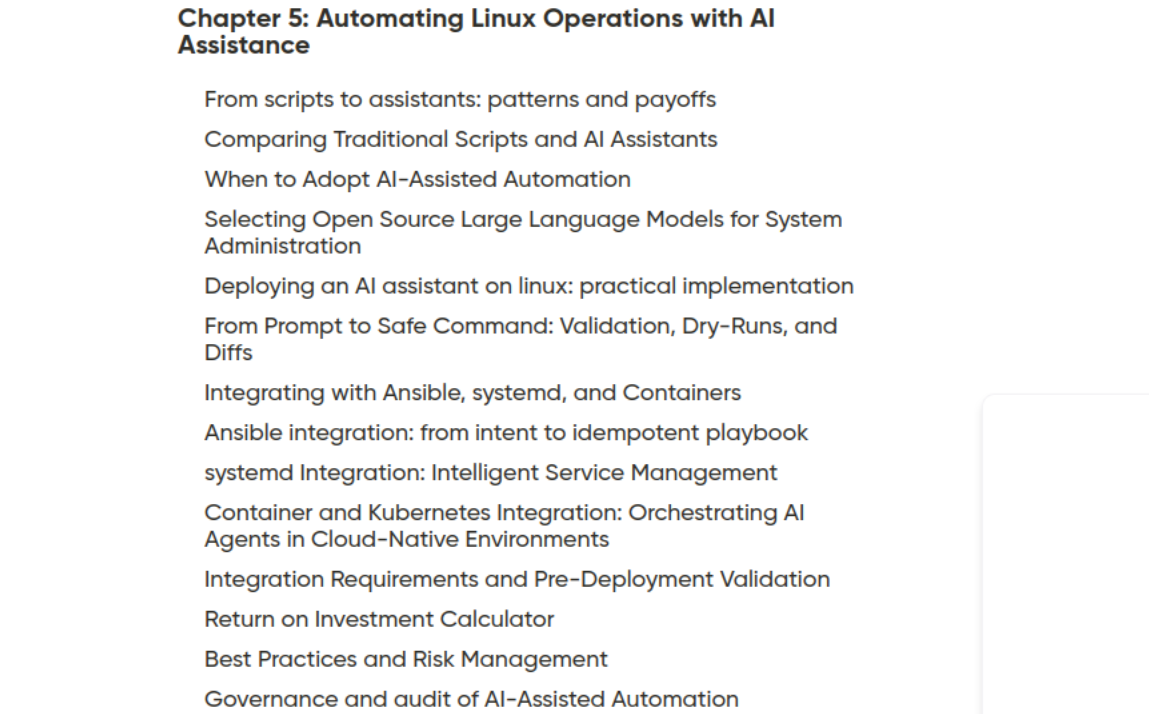
The book starts by explaining AI, machine learning (ML), and large language models (LLMs) specifically in Linux contexts, covering the practical differences between training, fine-tuning, and inference. The book also covers building RAG systems that index system logs, internal runbooks, documentation, and past incident reports to give you context-aware answers instead of hallucinated ones. This is where AI actually shines. When it has context, its analysis is far more accurate.Still unsure? To determine whether the book is for you, I advise checking it on the O’Reilly website. It has chapters of the books and you can expand those chapters to see the sections of those chapters. To move these concepts into real-world use, the book covers scaling and securing AI workloads on Kubernetes: managing GPU resources, implementing autoscaling based on inference-specific metrics, and optimizing performance through techniques like quantization. Although the book has 12 chapters and runs over 300 pages, I find that the book is divided into four core sectors:
1. Foundational knowledge
The authors push for moving from passive monitoring to a “dialogue model” of observability, through log dialogue pipelines. So, instead of manually grepping through logs, you build pipelines that compress and correlate multi-source logs into actionable knowledge. There are also examples and sample code you can adapt for your own workflow with some modification, like an anomaly detector you could plug into your Linux observability stack.
2. Intelligent automation and LinuxOps agents
That’s why seasoned Linux professionals, Ezequiel Lanza and Eduardo Spotti wrote the book The Ultimate AI Guide for Linux Engineers that I am reviewing here. The book is published by Packt and you can find it on Packt, O’Reilly and Amazon.It also lays out a full security stack, including threat modeling for AI, PII (personally identifiable information) redaction, prompt injection defenses, and using Open Policy Agent (OPA) to enforce strict guardrails on agent actions. This part matters more than people think; it’s usually the part companies skip, right up until they end up trending on social media over a security incident.
3. Intelligent observability and RAG
Overall, The Ultimate AI Guide for Linux Engineers is a practical, Linux-first handbook designed to help system administrators, SREs, and DevOps professionals fold AI into their daily workflows. Instead of focusing on theory, it lays out a roadmap for evolving from traditional shell scripts to intelligent, autonomous systems.The book ends by looking at the future of AI-driven Linux workflows, and the need to balance autonomy with human oversight.
4. Production deployment and security
The book opens with “Linux engineers have always been expected to do more with less,” and that’s the core idea of the book: using AI effectively to improve efficienncy.This book isn’t for you if you’re completely new to Linux or just a casual desktop user. You may still learn something, but unless you’re managing servers, containers, and infrastructure, you probably won’t find it as engaging or useful.A major focus of the book is the shift from static automation to intelligent automation. AI-assisted automation shows how to combine AI with traditional tools like Ansible, Bash, and systemd to generate safe, validated commands from natural language intent.
Verdict
Even Linus Torvalds is fine with AI being used in Linux kernel development these days, and it’s everywhere else in the Linux and tech world too. The time has come to stop ignoring AI and start using it as a tool and to use it well, especially if you are a professional sysadmin or DevOps.To reduce the risk of letting AI agents loose on your systems, the authors suggest best practices like role-based access, limiting operations to read-only wherever possible, and logging all AI actions for auditing. 💡
The best engineers will not be replaced by AI but will be the ones who know how to use it effectively.
Pay once, Enjoy forever
Note that the book is written for people who already know and use Linux professionally. That means sysadmins, devops, SREs, system engineers, network engineers. The book collectively calls them “Linux engineers” and I like that term.